Congressional-Trade Alpha — An Event Study
Across 5,763 House disclosures, sign-adjusted abnormal returns are roughly zero to slightly negative at every horizon a copy-trader could act on.
At a glance
- House PTR trades, 2022–2025
- 5,763
- Transaction-date CAR(+1,+21) (t)
- −0.28% (−2.22)
- Committee-relevant CAR (t)
- +0.18% (0.77)
About this project
An event study testing whether US House STOCK Act disclosures contain tradable alpha, the premise behind copy-trading apps and the NANC/KRUZ ETFs. 5,763 Periodic Transaction Report trades from mid-2022 to end-2025 are parsed from the raw PDF filings, joined to committee assignments and sector jurisdictions, and run through a market-model event study against SPY with a [−120, −20] estimation window, anchored on both the transaction date (the true informational edge) and the disclosure date (the tradable one).
Why it matters
The congressional-trading edge is widely publicised and widely sold. Measuring it properly, with the disclosure lag that a real copier faces and a committee-relevance split, shows how much of it survives: very little.
Methodology
- House financial-disclosure XML indexes filtered to Periodic Transaction Reports; concurrent PDF download with resume; a regex engine that handles single-line and wrapped two-line transaction formats plus options metadata.
- Filer-to-committee crosswalk mapped to the market sectors each committee has jurisdiction over; GICS sectors and daily prices for every traded ticker.
- Market-model cumulative abnormal returns against SPY, estimation window [−120, −20] trading days, anchored on transaction and on disclosure dates; t-statistics on sign-adjusted CARs.
Strongest findings
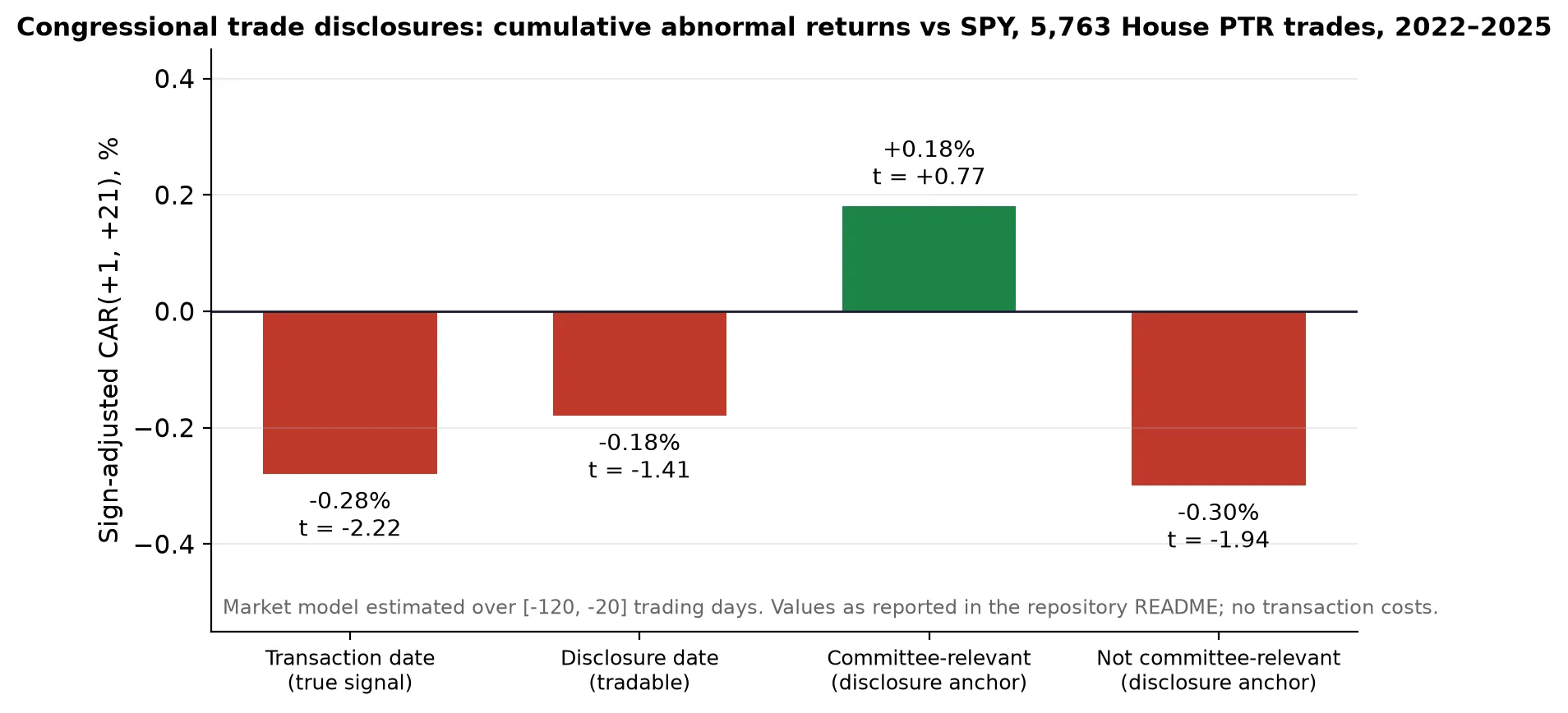
- Transaction-date CAR(+1, +21) is −0.28% (t = −2.22); disclosure-date CAR is −0.18% (t = −1.41).
- Committee-relevant trades earn +0.18% (t = 0.77) against −0.30% (t = −1.94) for the rest: the right direction, weak statistics, and an edge that costs would largely eat.
- The post-2012 median transaction-to-disclosure lag is only 14 days, so the signal is weak, not merely stale.
Robustness and caveats
- House only; Senate eFD filings are behind a session-based portal. Committee data are current-Congress only.
- A raw event study, not a backtest: no costs, sizing or options execution. The presentation notebook with the original charts is pending recovery; the figure shown is rendered from the reported results.
Challenges
Parsing messy disclosure filings, building a leakage-safe event window, and resisting the urge to torture a non-result into a signal.
Learnings
Event-study methodology, and that proving a negative rigorously is its own kind of result.