Volatility Risk Premia in CME G10 FX Options
The FX volatility premium is real, left-skewed and insurance-like; a leak-free high-IV selection rule roughly doubles the payoff proxy.
At a glance
- Daily root-tenor observations
- 70,714
- Static short-vol proxy (NW63 t)
- 0.28 vol-pts (1.79)
- Top-IV selection rule (NW63 t)
- 0.51 vol-pts (2.41)
- Roots negative in 2022
- 7 of 7
About this project
A research-grade panel of CME G10 FX options on futures, June 2010 to June 2026, built from Databento GLBX.MDP3 statistics and definitions (six batch jobs, 986 files, 11 GB raw) across seven currency roots at 30, 60 and 90-day tenors. Black-76 at-the-money implied volatility is compared with the forward realised volatility of each option’s own underlying futures contract, and twelve short-volatility payoff proxies are tested with Newey-West and non-overlapping inference. Every variant tested is disclosed.
Why it matters
Selling volatility is a core source of return for options market makers and macro funds, and FX is the asset class where the premium is least well documented at exchange level. The data work matters as much as the result: the 2017 CME symbol migration creates a false discontinuity in any naive long-horizon study, and the legacy NZD series carries an implied-volatility regime that is pure artefact.
Methodology
- Definitions and settlements joined per month through the definition-level underlying id; options mapped to the specific futures contract they reference; 0% unmatched across all 492 statistics role-months.
- Black-76 implied volatility per contract (r = 0, calendar-year tau); forward realised volatility over (t, t+H] from the underlying’s own settle series with a gap guard.
- ATM selection to 30/60/90-day targets by nearest tenor, global de-duplication and re-ranking on tenor distance, moneyness and open interest: 440,467 ATM rows, 70,714 daily root-tenor observations.
- The 2017 CME FX options symbol migration corrected with an explicit source rule (legacy symbols before July 2017, migrated symbols after, legacy 6N retained); the anomalous pre-2014 6N regime removed.
- Conditioning signal: trailing 252-observation IV z-score ending at t−1, minimum 126 observations, so no look-ahead enters any rule.
- Inference: Newey-West t at 5, 21 and 63 lags, non-overlapping 21-day subsamples, skew and excess kurtosis for every variant; full reproduction scorecard against the original pipeline (21 of the 22 comparable metrics identical; the one difference is 20 rows in 32.5 million).
Strongest findings
- Median implied exceeds median forward-realised volatility for six of seven roots; JPY carries the largest premium (+0.87 vol points) and NZD is flat.
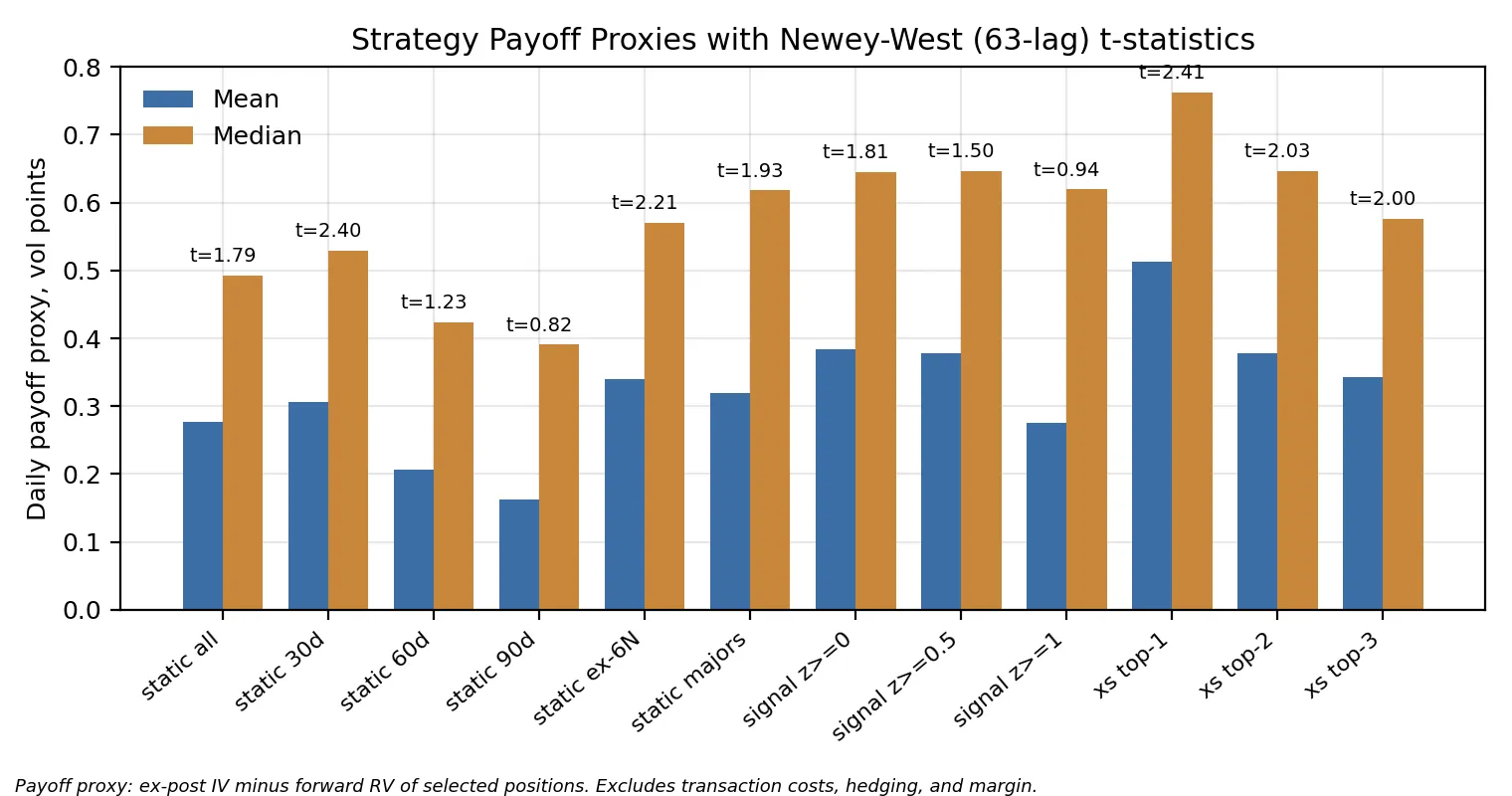
- A static short-volatility proxy across all roots and tenors averages 0.28 vol points per day (median 0.49, positive 65.6% of days) with NW63 t = 1.79 and non-overlapping t = 2.27; only the 30-day bucket is robustly significant on its own (t = 2.40).
- Selecting the single most IV-elevated root per date and tenor raises the mean to 0.51 vol points (median 0.76) with NW63 t = 2.41 and non-overlapping t = 2.71, with monotone attenuation for top-2 and top-3.
- Time-series threshold rules on a cell’s own z-score add little once the signal is restricted to trailing information; the improvement from conditioning is in payoff magnitude, not hit rate.
- The distribution is left-skewed in every variant (static skew −1.69, excess kurtosis 7.0); 2022 is a broad stress year in which short volatility loses on all seven roots.
Figures
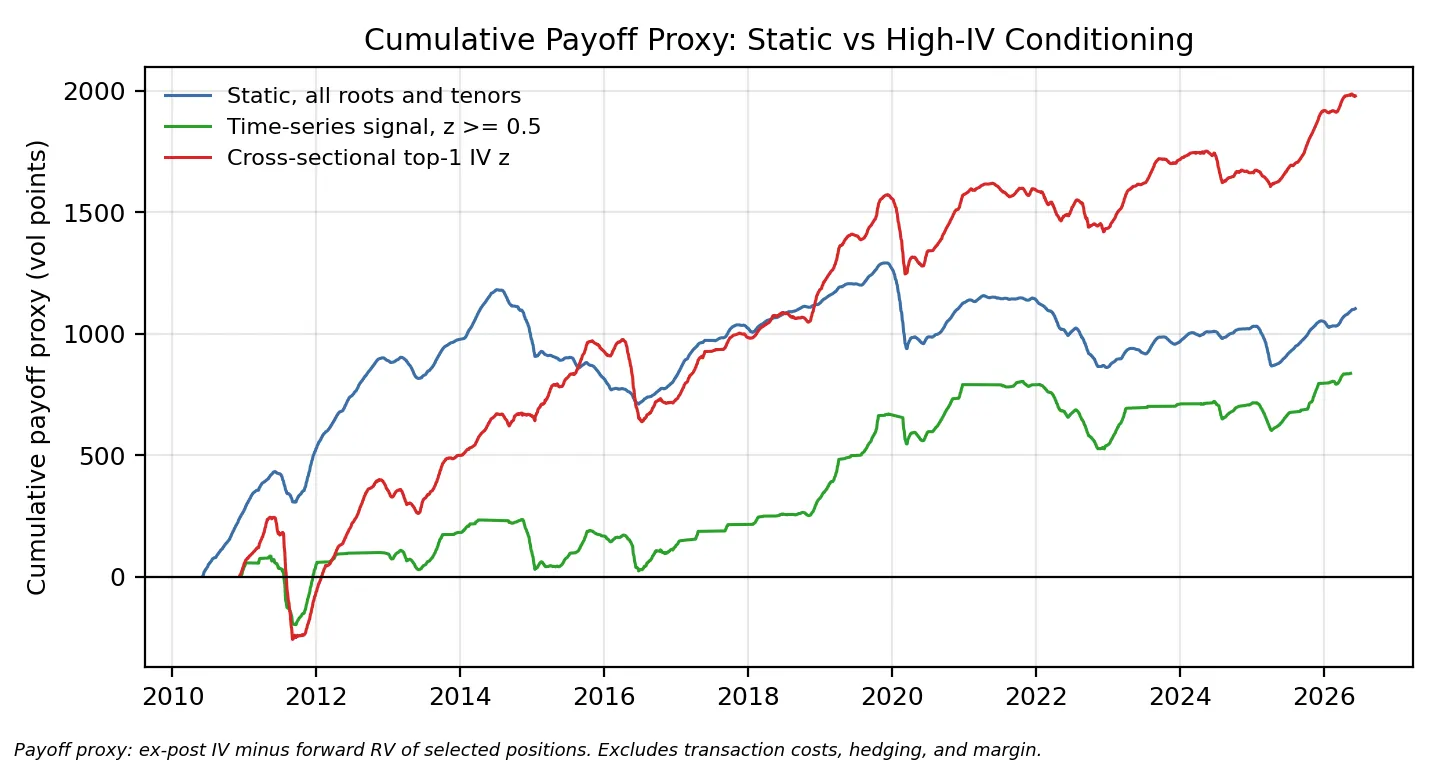
Figure 1. Cumulative payoff proxy 2010–2026: static (blue), time-series z ≥ 0.5 (green), cross-sectional top-1 IV z (red). 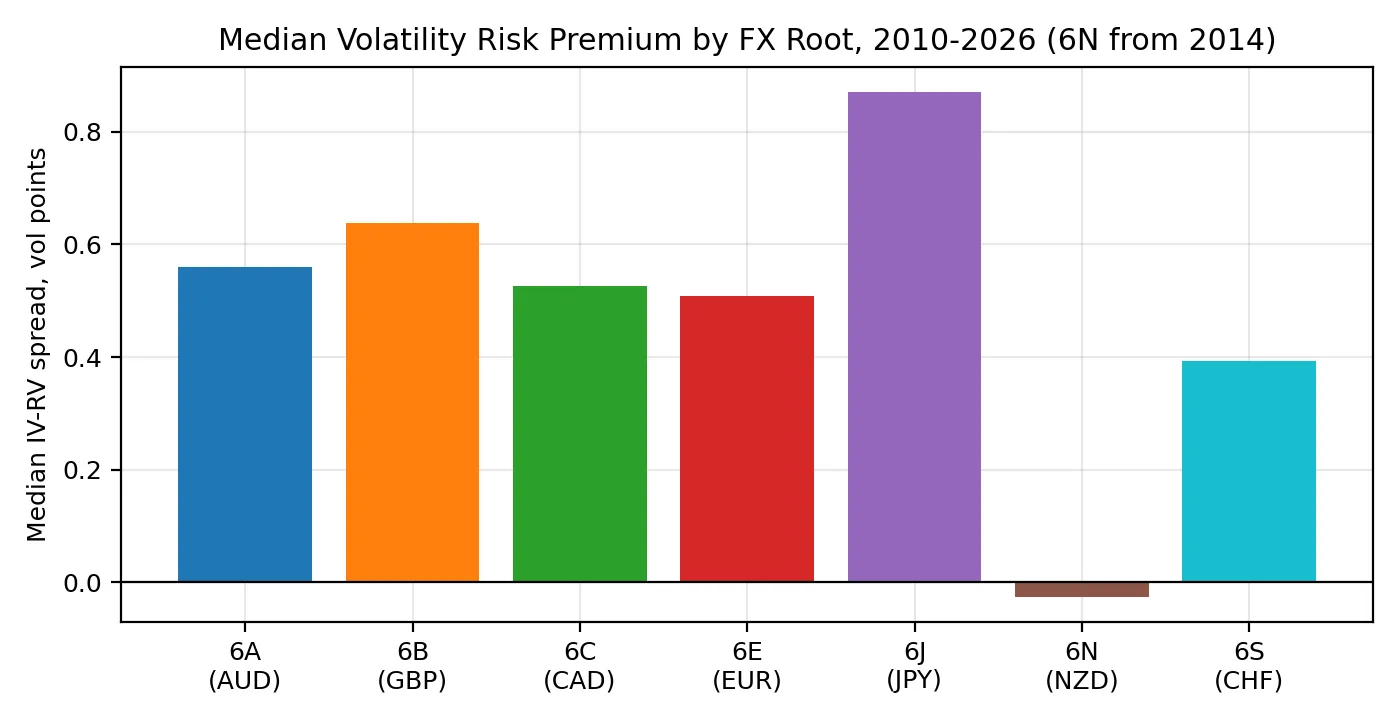
Figure 2. Median IV−RV spread by root: positive for six of seven, JPY strongest, NZD flat once its legacy regime is removed. 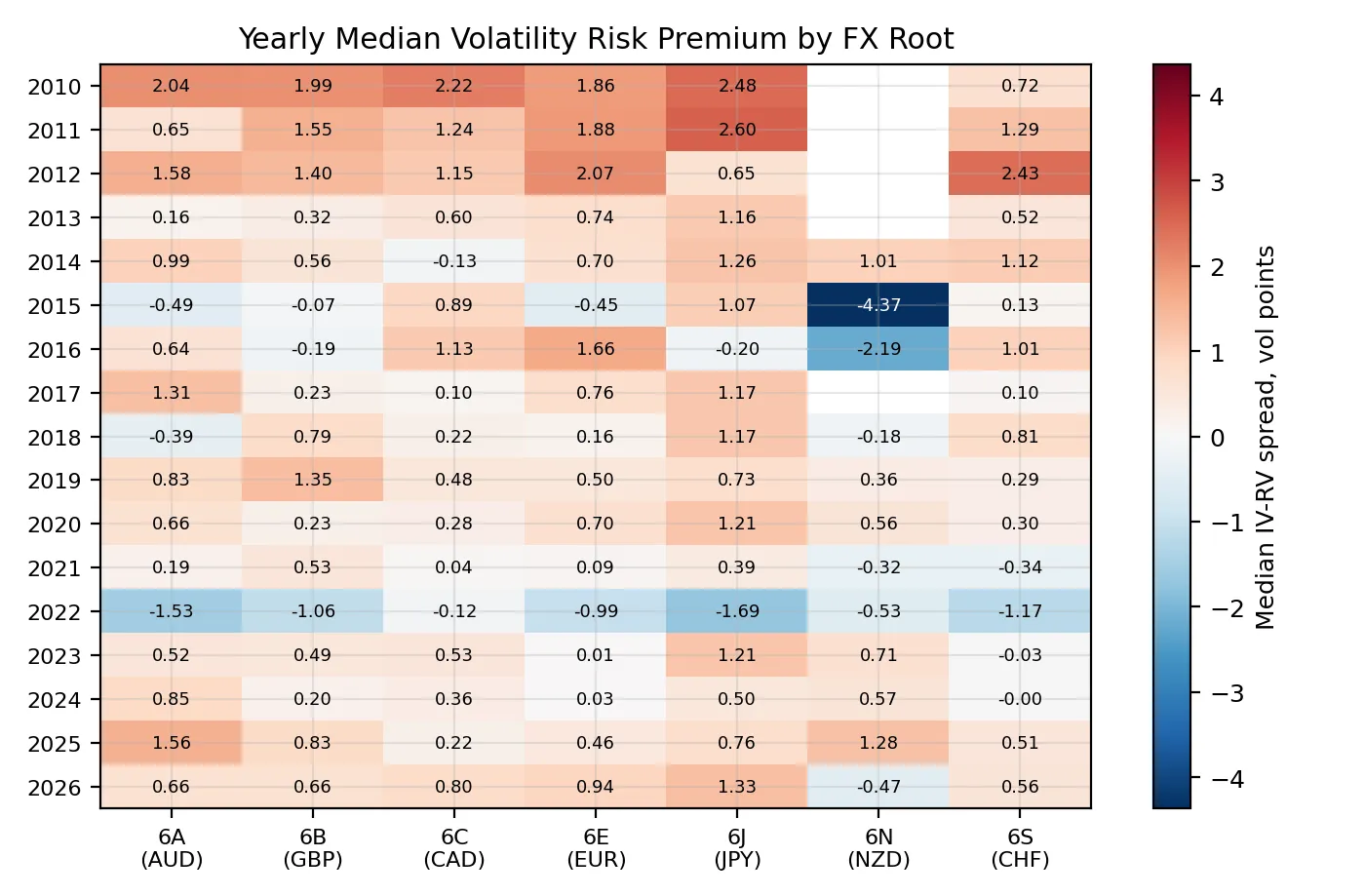
Figure 3. Yearly median premium by root: 2015 (NZD, the thin market, with AUD and EUR also negative) and 2022 (all seven roots) are the stress years; CHF is positive in 2015. 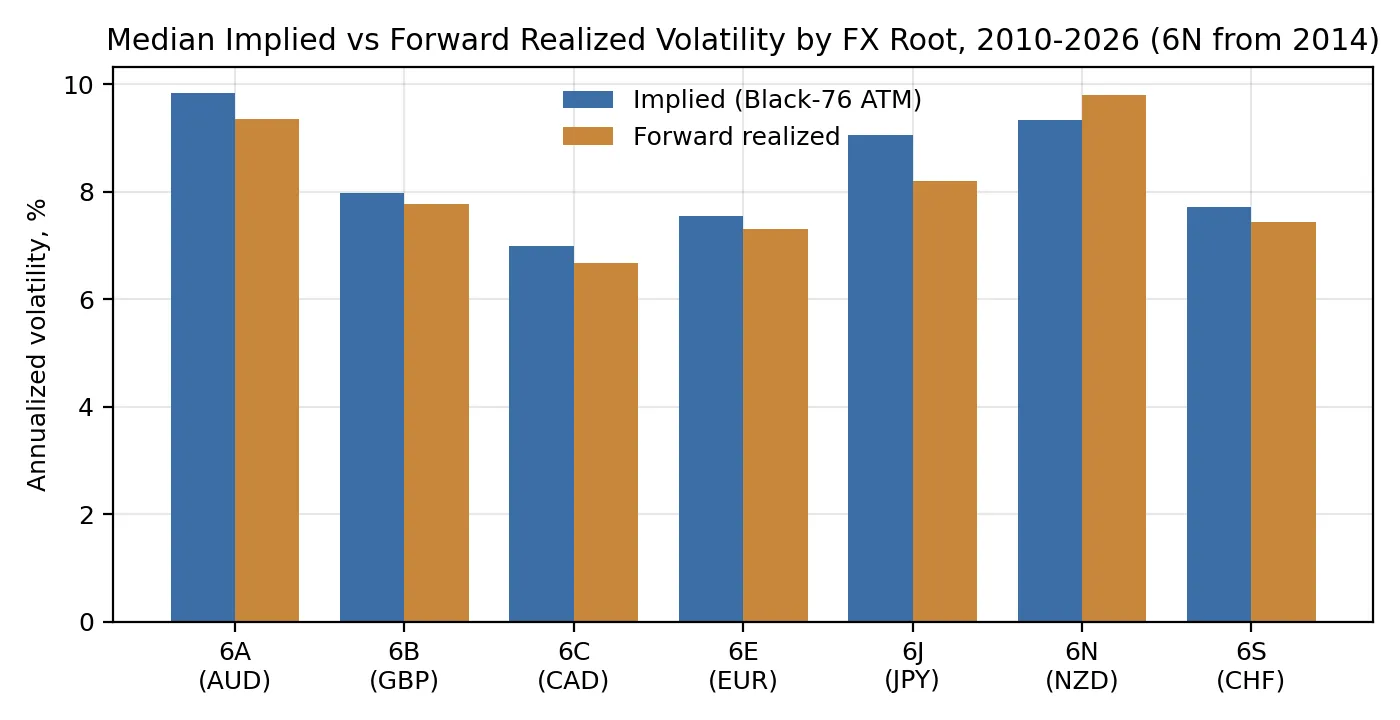
Figure 4. Median Black-76 ATM implied against forward realised volatility by root, 2010–2026 (NZD from 2014). 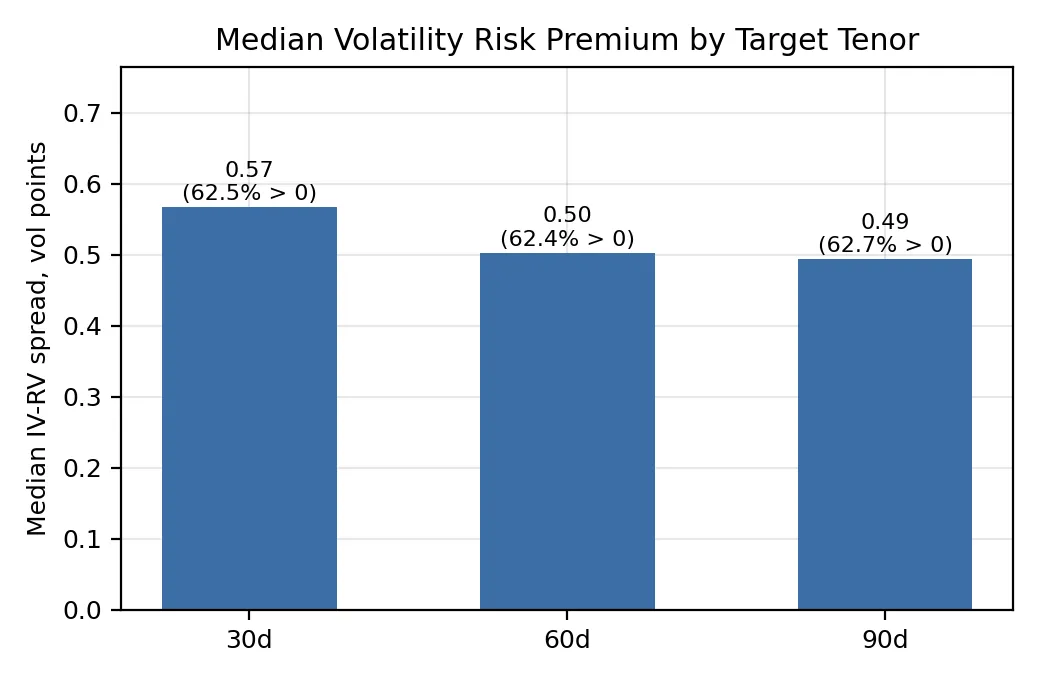
Figure 5. Median premium and share of positive days by tenor. In the strategy tests (table 3) the 30-day bucket is the only one robustly significant on its own (NW63 t = 2.40).
Robustness and caveats
- Payoff proxies, not P&L: settlement marks, no transaction costs, no delta hedging, no margin.
- Interest rate set to zero in the Black-76 inversion; the premium is insensitive to it at these tenors but the convention is stated.
- NZD remains thin even after 2014 (roughly 78% of daily cells have zero open interest).
- Raw and derived Databento panels are licensed and not redistributed; the repository ships the full pipeline, aggregated tables and a reproduction scorecard.
Challenges
Reconstructing a consistent 16-year options panel across the 2017 CME symbol migration, detecting and removing the legacy NZD implied-volatility artefact, and keeping the conditioning signal strictly leak-free after an earlier draft had used a full-sample z-score.
Learnings
The data contributions were larger than the strategy result. The premium is a left-skewed insurance premium: conditioning changes magnitude, not hit rate, and 2022 shows what the tail looks like.