Global Rates Relative Value
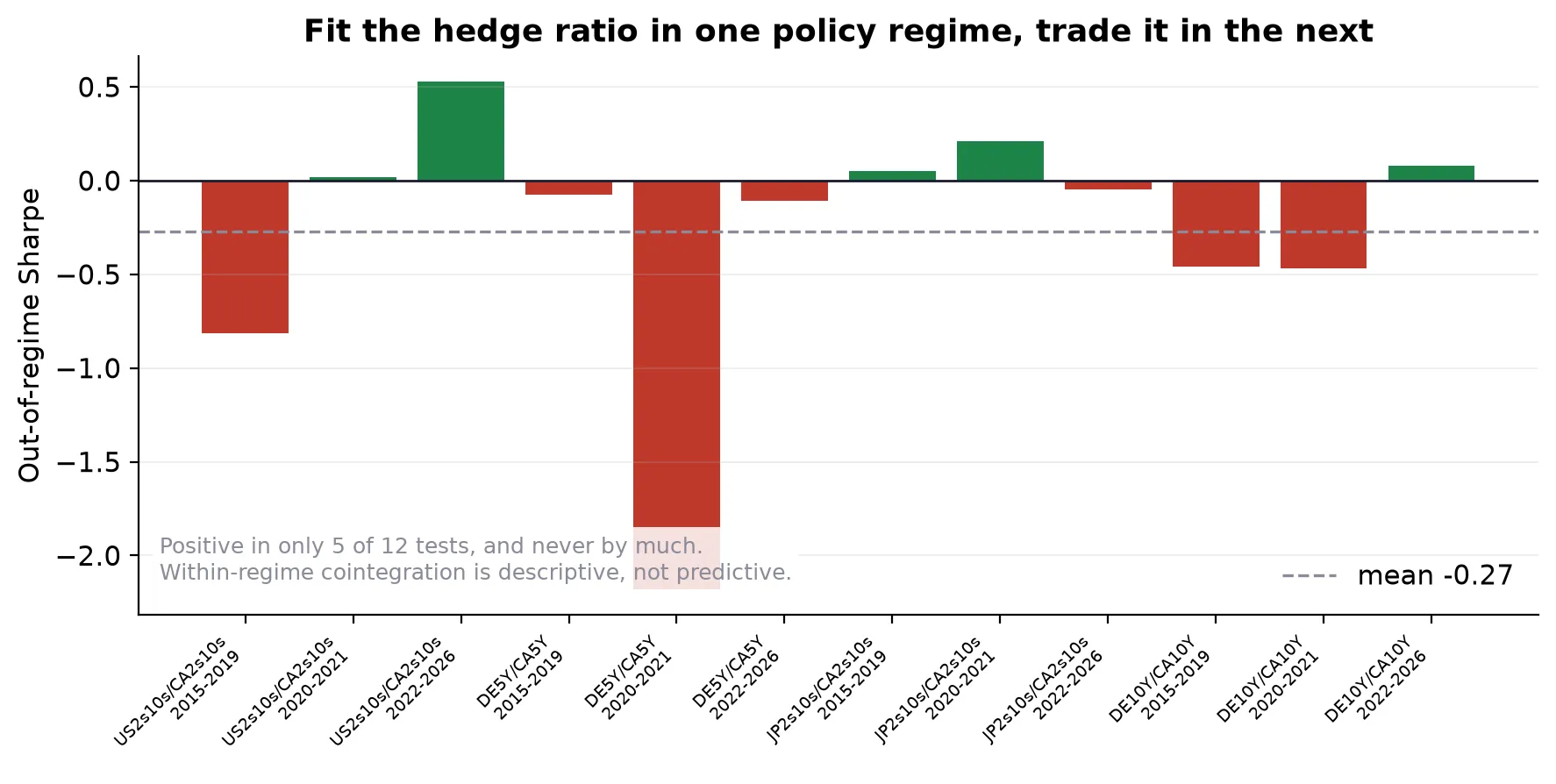
Cross-country yield spreads were not cointegrated out of regime over 2010–2026; the hedge ratio found in one regime is the wrong position in the next.
At a glance
- Cointegrated pairs, full sample
- 0 of 18
- Within regimes pass / survive FDR
- 11 of 144 / 6
- Out-of-regime mean Sharpe
- −0.27
- FX contamination R²
- ≤ 0.0016
About this project
A test of a common idea: that developed-market yield curves are tied by long-run equilibria that can be traded when they diverge. The pipeline screens every candidate pair for cointegration, trades survivors with a z-score state machine on DV01-neutral legs, controls the false-discovery rate, and, critically, checks whether relationships found in one monetary-policy regime survive into the next. They do not, and the repository presents the full screen table rather than a cherry-picked survivor.
Why it matters
2010–2026 spans divergent QE programmes, the ECB’s negative-rate era, the Bank of Japan’s yield-curve control and desynchronised post-COVID hiking. A stable long-run equilibrium between two curves is a strong assumption, and this period violates it. Without FDR control and the out-of-regime test, the 11 raw within-regime survivors (6 after FDR) would have looked like discoveries; none of them trades profitably in the next regime.
Methodology
- Free public data only: FRED (US yields), Bundesbank Svensson curves, Japan MoF JGB curve, Bank of Canada Valet, ECB FX; 3,762 aligned daily observations 2010-01-04 to 2026-06-30.
- Eighteen candidate pairs across 2Y/5Y/10Y/30Y levels and slopes; Engle-Granger and ADF screening on the full sample and within four policy regimes; Benjamini-Hochberg FDR control.
- Survivors traded with a z-score state machine on DV01-neutral legs via a shared research core (ratslib); forward test fits the hedge ratio in one regime and trades the next.
- FX contamination measured explicitly against the relevant currency pair.
Strongest findings
- Full sample: 0 of 18 candidates cointegrated.
- Within policy regimes: 11 of 144 tests pass the screen and 6 survive FDR correction, with half-lives of 8–25 days among the FDR survivors; Canada appears in 10 of the 11 raw survivors.
- Fit one regime, trade the next: mean Sharpe −0.27, positive in only 5 of 12 tests. The hedge ratio for DE5Y/CA5Y runs 1.28, 0.04, 0.15, 0.95 across the four regimes and DE10Y/CA10Y swings 1.20 → 0.43 → 0.26 → 1.39.
- FX contamination R² is at most 0.0016, so the negative result is a rates finding, not a currency artefact.
Figures
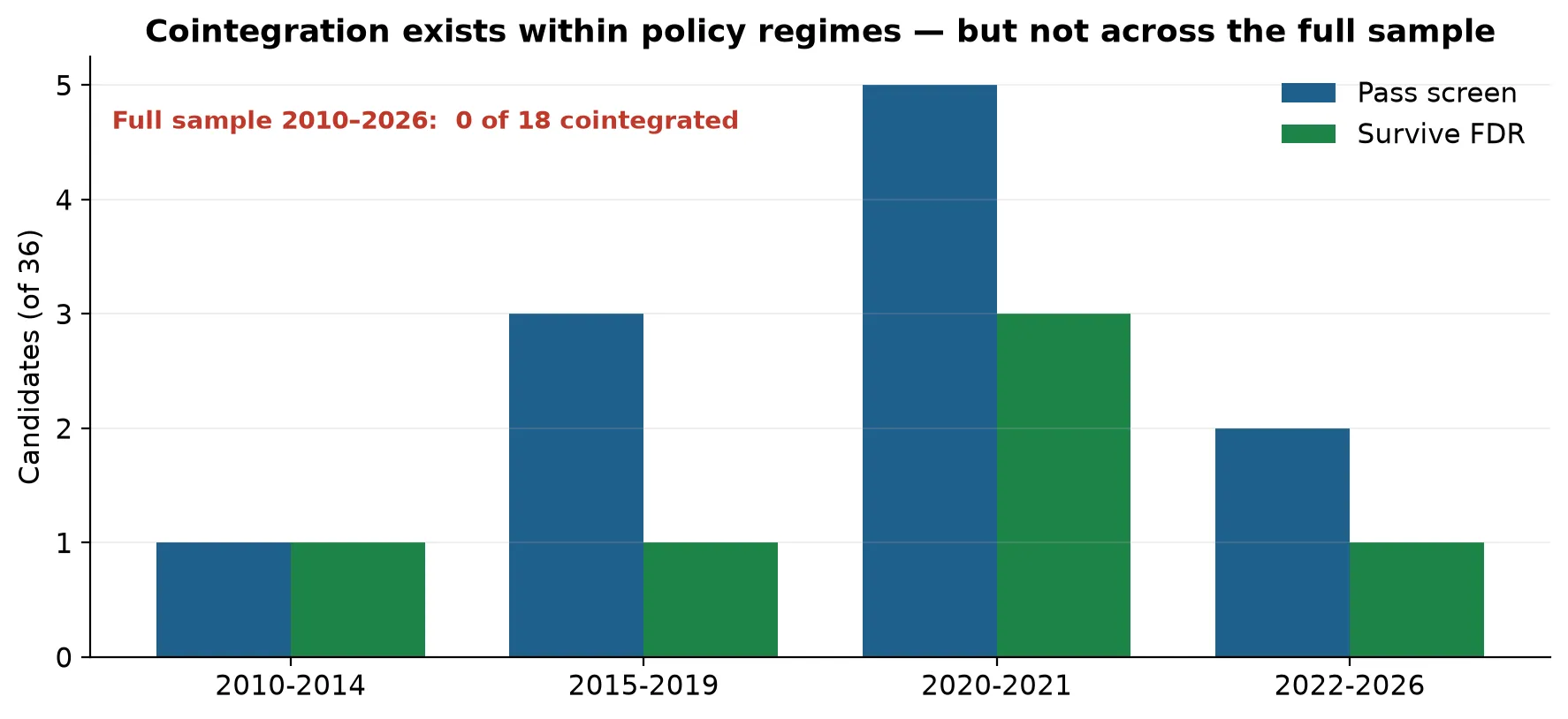
Figure 1. Cointegration exists within policy regimes (11 of 144 pass, 6 survive FDR) but not across the full sample (0 of 18). 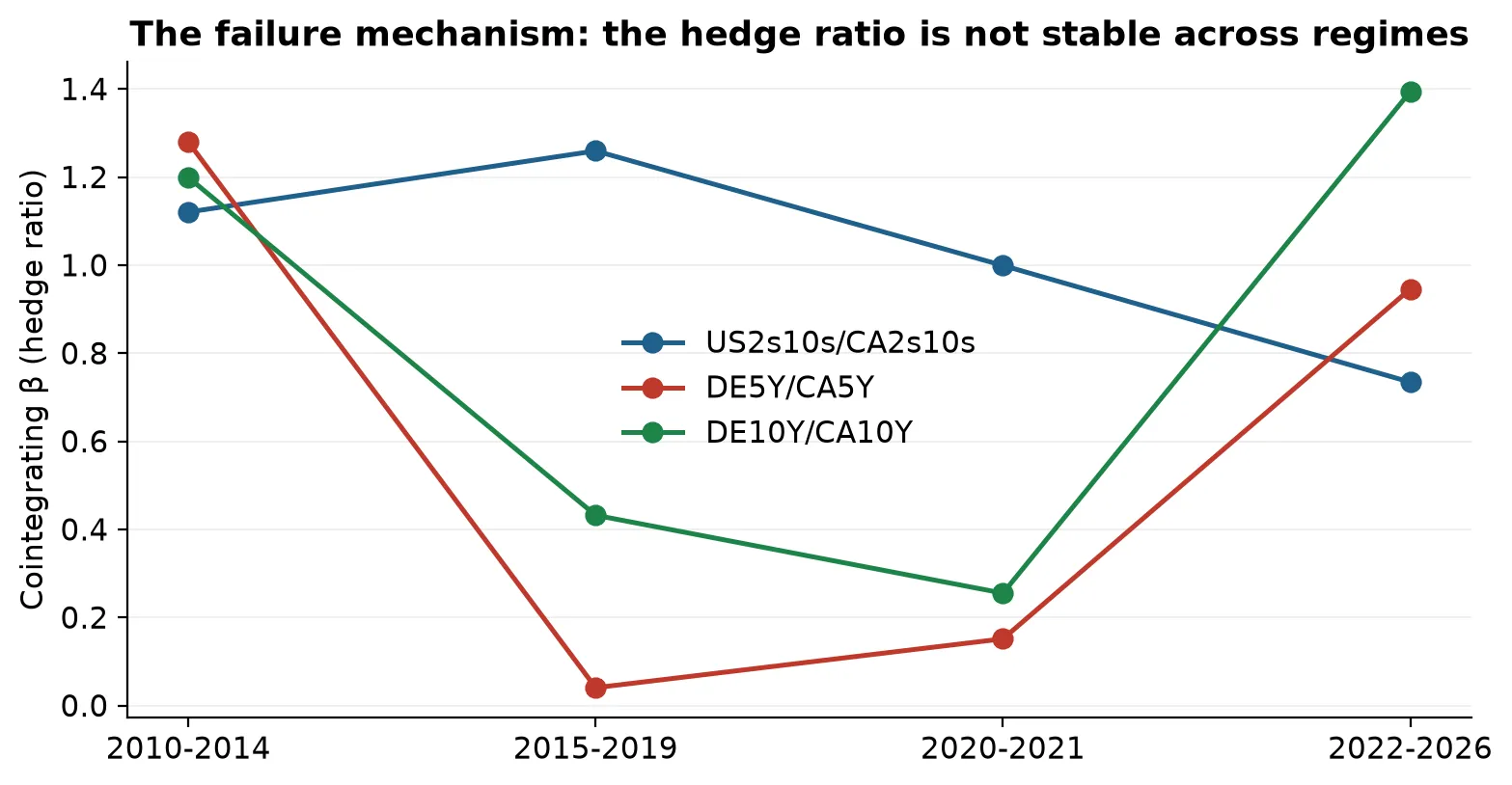
Figure 2. The failure mechanism: the hedge ratio is not stable across regimes. 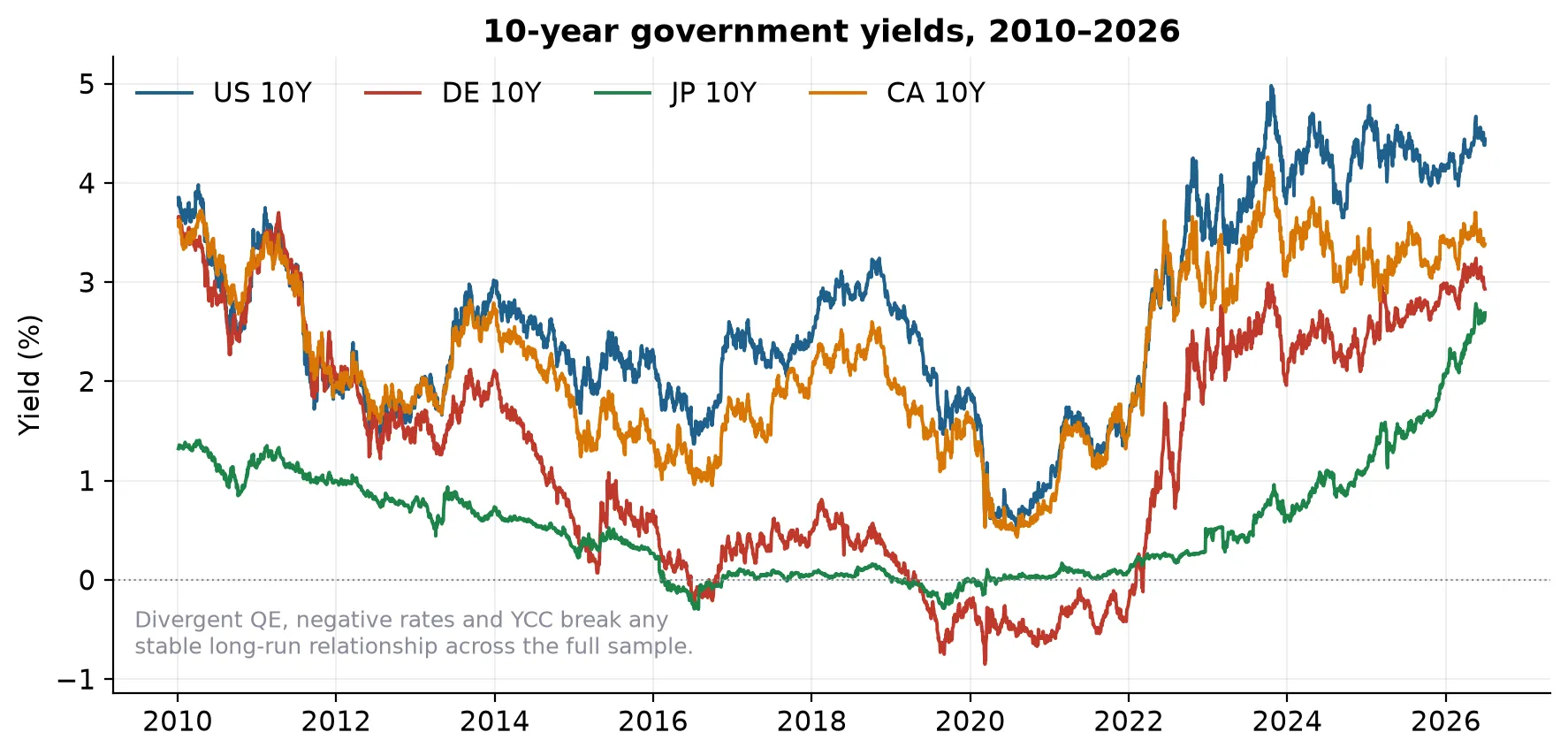
Figure 3. Divergent QE, negative rates and yield-curve control break any stable long-run relationship across the full sample.
Robustness and caveats
- Research stage complete and presented as a negative result; the repository’s own manifest still marks the project in progress because a live FX-adjusted layer and a wider market set were scoped and not built.
- Canada 30Y is the Bank of Canada’s generic long benchmark rather than a constant maturity; Japan 2Y has 1,106 zero-change days under yield-curve control.
- Rebuilt on 2026-08-23 on FRED US yields: the original run had cached a Bloomberg US export, which is not redistributable. On FRED the screen is more permissive (11 raw passes against 7; FRED publishes yields to two decimals, which flattens residuals) and the out-of-regime mean is −0.27 against −0.32, with the same conclusion.
Challenges
Building free-data loaders with rate-limit backoff across five central-bank sources, and designing a regime test strict enough to reject relationships that looked tradable within sample.
Learnings
Multiple-testing discipline earned its keep immediately. Within-regime cointegration is descriptive, not predictive.